Civic records Early twentieth century
The Nineteenth Amendment and the work of voting
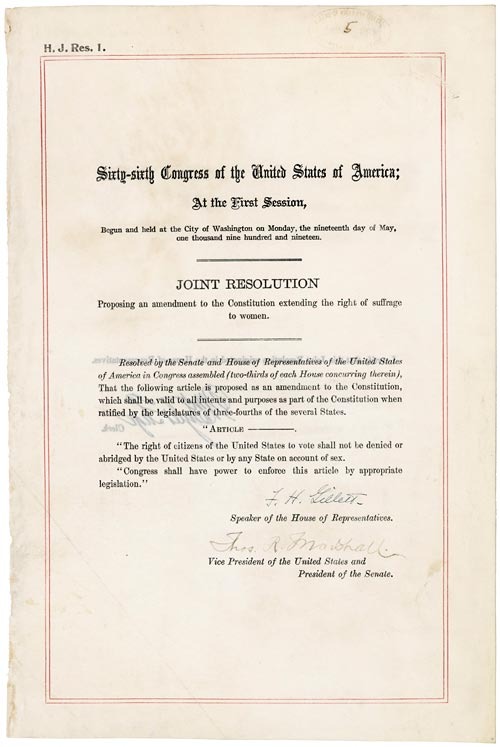
Congress proposed the Nineteenth Amendment in June 1919 after decades of organising, lobbying and protest. The states then had to ratify it; the necessary threshold was reached in August 1920. The joint resolution shown here belongs to the congressional stage, not the final ratification. Its short text barred denial of voting rights on account of sex. That legal change was consequential, but it did not sweep away racial disfranchisement, citizenship restrictions or other barriers. The history of women voting therefore continues beyond the amendment, through the people who still had to fight for practical access to the ballot.
About the picture
The document carries more than one historical time marker. The congressional session began in May 1919, while the amendment passed Congress in June and took effect after ratification in 1920. Its brief constitutional wording emerged from a long movement, and its enforcement remained part of later struggles over voting rights.
The history behind it
Start with the authentic reference
The National Archives supplies the unchanged image and transcript of the Congressional joint resolution proposing the Nineteenth Amendment. Its header names the first session beginning in Washington on 19 May 1919. The resolution’s Congressional approval date is 4 June 1919. The session-opening date and the completed passage date can both be correct because they identify different stages, even though they appear in the same document’s history.
An exercise, not a newly discovered forgery
The comparison text is explicitly an editorial exercise. It changes the header’s spelled-out year from nineteen to twenty while leaving its month and day intact. That is enough to reject it as a literal transcription of the reference. It is not evidence that a historical archivist falsified the paper, and no historical image has been altered. The original-language excerpt and its Spanish translation must also be distinguished: a translation helps readers but is not the wording printed on the original page.
Proposal is not ratification or certification
The register separates Congressional proposal from state ratification, completed on 18 August 1920, and certification on 26 August. A familiar later year cannot justify silently replacing the source’s year. Nor does the amendment’s legal milestone establish that voting barriers immediately vanished for all women; the National Archives describes continuing discriminatory obstacles. Document comparison should preserve both the exact textual finding and the limits of the record. A documentary date is not the same evidence as a laboratory analysis of the physical ink. No such report is supplied here, so the claim that a test independently confirmed 1919 remains undecided without calling the genuine archival image into question.
A few things to read next
Books for a longer visit, and a few good places to start online. These are ordinary links, with no affiliate commission.
On the bookshelf
The Woman’s Hour: The Great Fight to Win the Vote
Follows the close contest over Tennessee’s ratification in 1920.
Why They Marched: Untold Stories of the Women Who Fought for the Right to Vote
Introduces organisers whose work broadens the familiar story of a few national leaders.
Vanguard: How Black Women Broke Barriers, Won the Vote, and Insisted on Equality for All
Tracks Black women’s political organising and the barriers that remained beyond 1920.
Read online
Nineteenth Amendment to the United States Constitution
A starting point for names, dates and related subjects. Follow its references when you want to go further.
19th Amendment to the U.S. Constitution: Women’s Right to Vote
The resolution, a transcript and the chronology of passage and ratification.
From Susan Ware, a New Story of U.S. Women’s Suffrage Struggle
A history feature on Susan Ware’s research into the people behind the suffrage movement.
Where the pictures come from
The original records and their individual rights statements are below. The pictures have not been generated or altered for the game.
Joint resolution proposing the Nineteenth Amendment, approved 4 June 1919. The session-opening header names 19 May 1919; it is not a ratification certificate.
National Archives, Record Group 11, National Archives Identifier 596314 · 1919
Public domain: official U.S. federal legislative document. National Archives reproduction credited.
EDITORIALLY MODIFIED EXERCISE. This text is deliberately altered for comparison. It is not a quotation of the original header and is not a historical forgery discovered by the archive.
Data Barnacle exercise; authentic reference supplied by the National Archives · 2026-11-01
Original editorial exercise adapting public-domain federal document text; no claim of historical authenticity.
Editorial chronology paraphrased from the National Archives; distinguishes the date in the session header from later legal steps.
National Archives / Data Barnacle source notes · 2026-11-01
Original editorial paraphrase of public federal records; authentic document rights stated separately.
History notes and reading lists prepared for Data Barnacle with AI assistance. The source institutions and authors are not sponsors or endorsers. Suggest a correction or another source