Science & invention 1900s
The Wright brothers at Kill Devil Hills
On December 17, 1903, Orville Wright lay at the controls of a small aircraft on the North Carolina coast while Wilbur ran alongside. The first flight lasted only twelve seconds. That brief journey followed years of glider trials, measurements and work on controlling an aircraft in three dimensions. The brothers had chosen the Outer Banks for its wind and open sand. Their next problem was to turn a successful experiment into a machine that could fly reliably; much of that work took place back in Ohio at Huffman Prairie.
About the picture
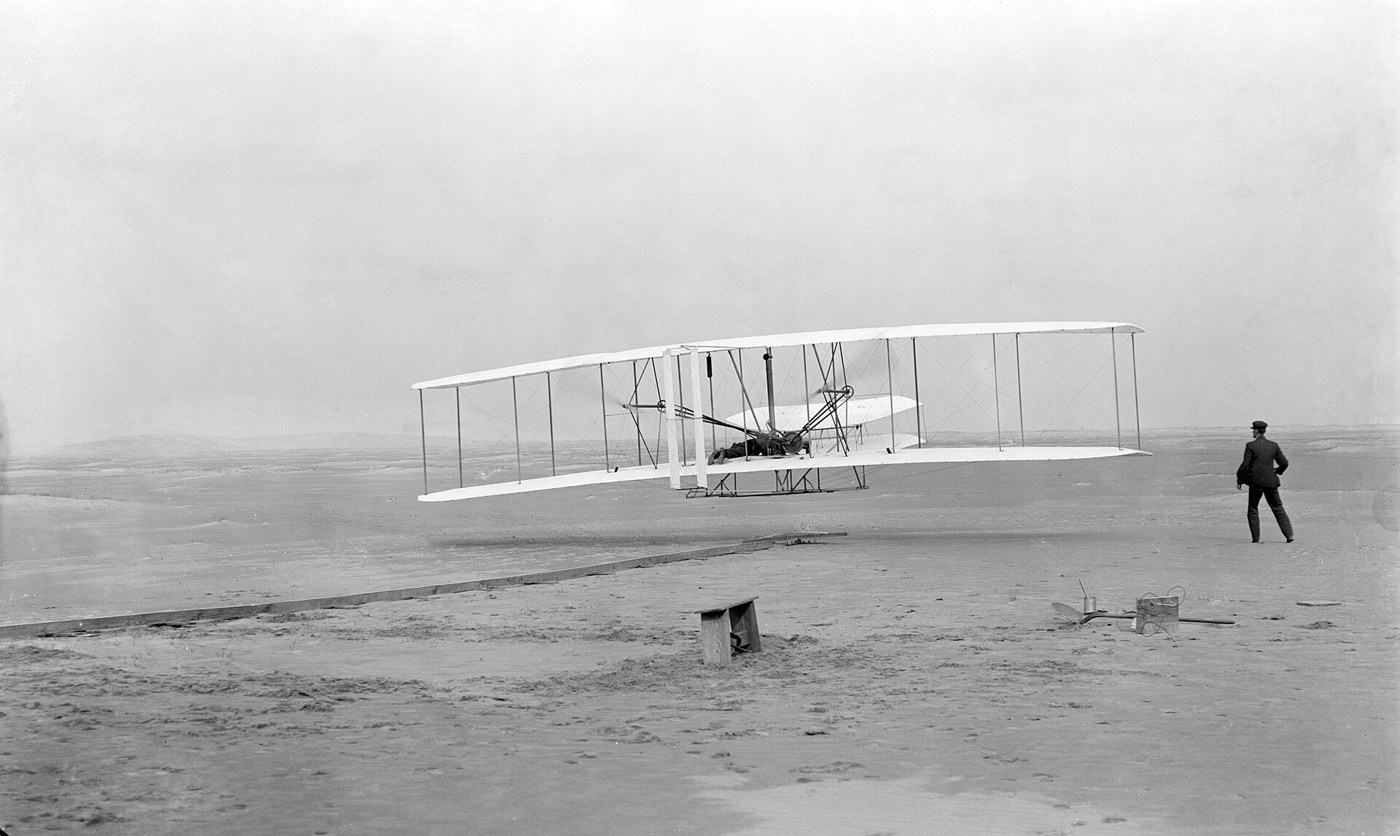
John T. Daniels caught the Flyer just after it left its launching rail, with Orville aboard and Wilbur beside the wing. The photograph records the first of four flights that morning. The rail gave the machine a smooth start across sand that could not serve as a conventional runway.
The history behind it
What the archive establishes
John T. Daniels recorded the Wright Flyer at Kill Devil Hills on December 17, 1903. Orville controlled the machine and Wilbur was beside it. NPS describes the engine, pusher propellers and launch rail at this coastal camp. The close alternatives are important: earlier glider work also used exposed machines and dunes, while the later Huffman Prairie experiments developed turns and circles and introduced a starting derrick. A rail is not proof of that later catapult. The sandy setting and the source identification distinguish this exposure from the Ohio pasture, French demonstrations and army trials. The photograph documents one short powered flight, but it cannot by itself establish its duration, the total number of flights that day or a completed circular route.
Date, place and phase
The record identifies the 1903 powered coastal flights. Earlier glider work and later Ohio circuits are neighboring but different experimental phases. Sand and the rail fit the documented Kill Devil Hills camp. The later Huffman Prairie field was an Ohio pasture and used a launching derrick. This is a powered launch and short flight, not proof of a full circuit. The starting rail must not be mistaken for the later catapult mechanism.
What the frame leaves open
A helper’s position does not establish that they propel the machine. The archive identifies a powered flight; the still frame cannot show the entire launch sequence. A single exposure and its identified date do not count the other flights that day. That needs a log or another record. A rail guides a launch but is not itself a catapult. NPS distinguishes the later Ohio launching derrick from the 1903 coastal launch.
A few things to read next
Books for a longer visit, and a few good places to start online. These are ordinary links, with no affiliate commission.
On the bookshelf
The Wright Brothers
A readable account of the brothers, their family and their experiments.
The Bishop’s Boys: A Life of Wilbur and Orville Wright
A detailed biography with particular attention to the brothers’ working lives.
Falling Upwards: How We Took to the Air
The earlier ballooning tradition provides a useful comparison with powered, controlled flight.
Read online
Wright brothers
A starting point for names, dates and related subjects. Follow its references when you want to go further.
1903: the first flight
A close account of the four flights on December 17.
Huffman Prairie Flying Field
What the Wrights still had to learn after their North Carolina success.
Where the pictures come from
The original records and their individual rights statements are below. The pictures have not been generated or altered for the game.
First flight of the Wright Flyer, North Carolina Outer Banks, December 17, 1903.
John T. Daniels / Library of Congress, via Wikimedia Commons · 17 December 1903
Public domain
History notes and reading lists prepared for Data Barnacle with AI assistance. The source institutions and authors are not sponsors or endorsers. Suggest a correction or another source