Scientific instruments 1650s
An astrolabe made in seventeenth-century Iran
An astrolabe puts a model of the sky into a hand-held instrument. Its engraved circles and moving parts bring geometry into contact with observations of the sun and stars. This example was made by Muhammad Zaman al-Munajjim al-Asturlabi and is attributed to Mashhad, Iran. Its date, 1065 in the Islamic calendar, corresponds to 1654–55 in the Gregorian calendar. Brasswork, lettering and calculation meet in the same object. Such instruments could help with timekeeping and astrological calculations, though this particular example’s size limited the precision of astronomical observations.
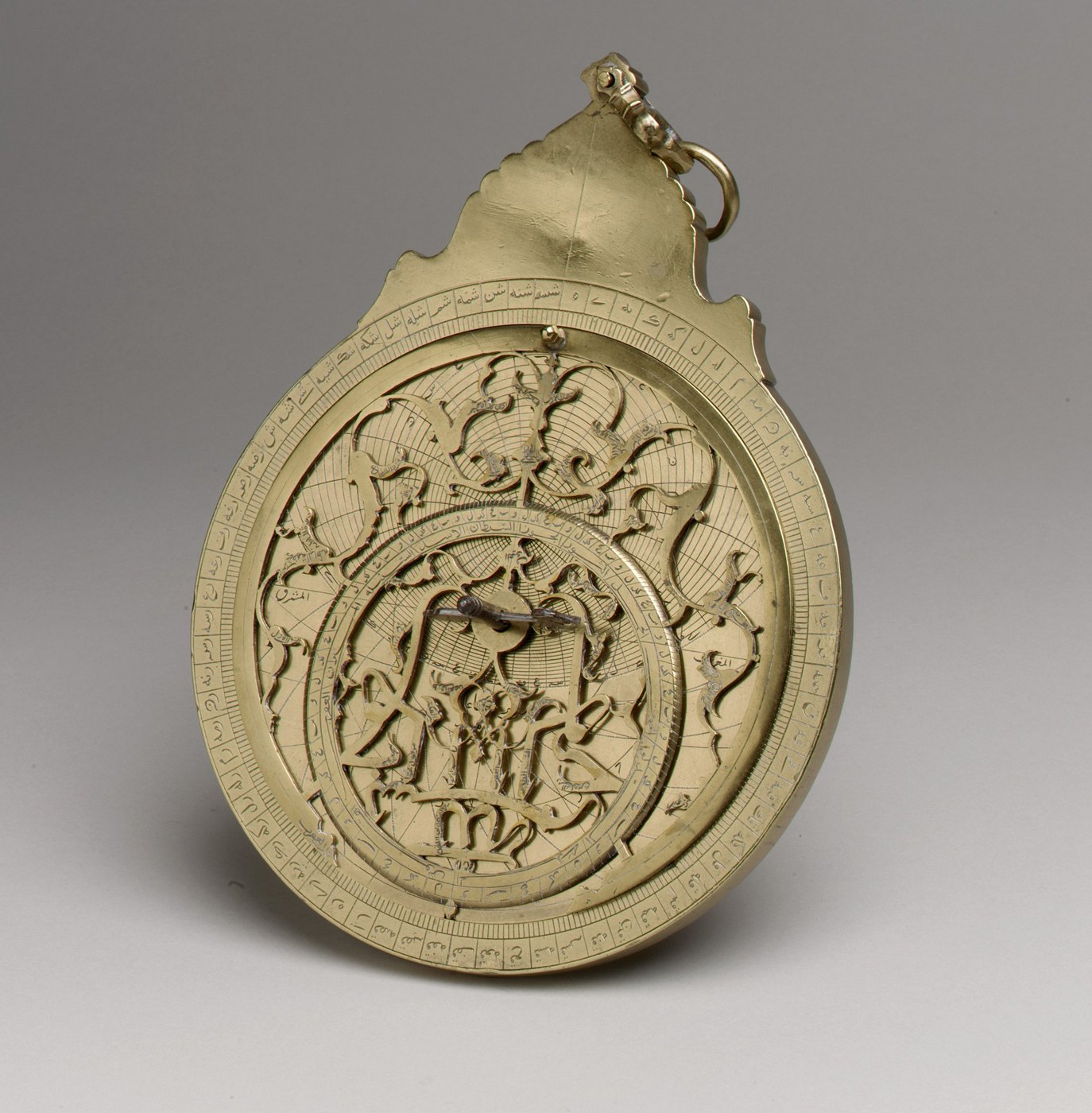
A closer look: The pierced sky plate
The openwork front is a mathematical arrangement as well as skilled metalwork. An astrolabe represents the curved heavens on a flat surface, allowing relationships between celestial positions and the local horizon to be explored. Its engraved lettering records the knowledge and craftsmanship built into the instrument.
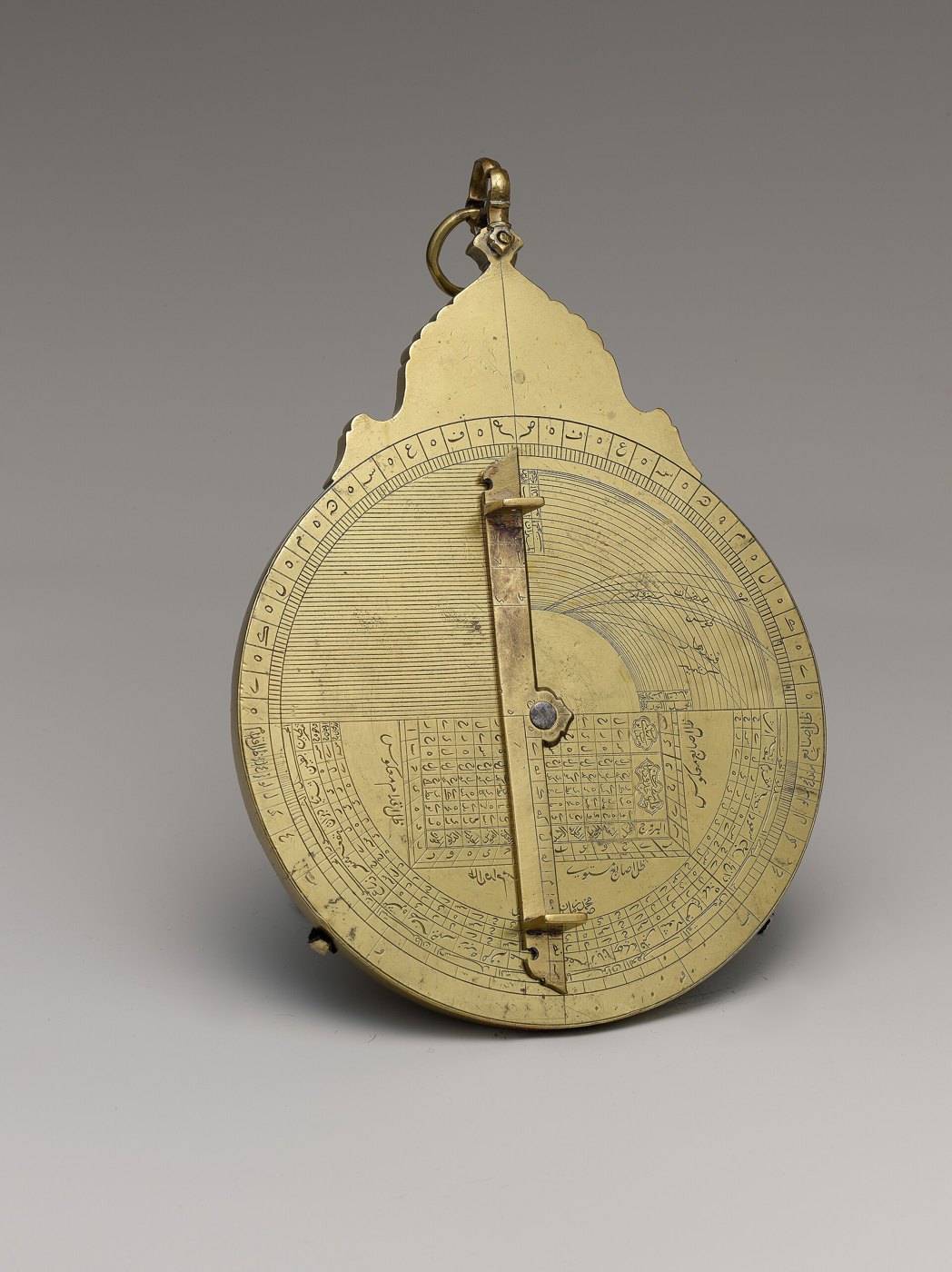
A closer look: The reverse and its rule
The separate components reveal that an astrolabe was assembled for use, with parts that could move against one another. Different plates could accommodate different observing latitudes. This practical flexibility helped the instrument travel between mathematical traditions, while local makers developed their own materials, lettering and decorative choices.
The history behind it
What the source establishes
The engraved scales and moving elements support reading the object as a calculating instrument as well as crafted metalwork. Its identity and capabilities are supplied by the museum rather than guessed from ornament. The calendar labels describe one historical date in different systems, while the museum’s 1963 credit belongs to the object’s later collection history. The geography is deliberately qualified: attributed to Mashhad is not the same as an unqualified signed street address. Finally, usefulness and precision are different questions. The record describes time-related use without certifying the level of precision required for every astronomical observation.
Dates, places and close alternatives
1065 AH / 1654–55 CE is a paired calendar date for the object, not a disagreement or photographic date. The catalogue attributes the instrument to Mashhad in Iran; the present New York repository is a separate geographical fact. The museum identifies a planispheric astrolabe, while its caution prevents overstating the accuracy of historical measurements.
Keep every qualification attached to its claim
A museum attribution is a scholarly claim with a stated degree of confidence. Preserve that qualification when writing a shorter caption. The same care applies to calendar labels and collection-credit dates: identify what each date describes before comparing its numeral with another. Finally, separate an instrument’s documented uses from the precision needed for a particular task. Elaborate metalwork alone does not certify a numerical measurement.
A few things to read next
Books for a longer visit, and a few good places to start online. These are ordinary links, with no affiliate commission.
On the bookshelf
The History & Practice of Ancient Astronomy
Explains the geometrical traditions behind instruments for observing and calculating the sky.
The History of Cartography, Volume 2, Book 1: Cartography in the Traditional Islamic and South Asian Societies
The celestial mapping chapters place instruments within Islamic mathematical and cartographic traditions.
Read online
Astrolabe
A starting point for names, dates and related subjects. Follow its references when you want to go further.
Science and the Art of the Islamic World
An illustrated teaching chapter that discusses this particular astrolabe.
The Astrolabe
A clear explanation of the instrument’s projection, parts and historical uses.
Where the pictures come from
The original records and their individual rights statements are below. The pictures have not been generated or altered for the game.
Planispheric Astrolabe, attributed to Iran, Mashhad, dated 1065 AH / 1654–55 CE; Met object 63.166a–j.
The Metropolitan Museum of Art, Harris Brisbane Dick Fund, 1963, 63.166a–j · Object dated 1065 AH / 1654–55 CE; photograph is modern
CC0 1.0: museum-released Open Access image of a public-domain object.
History notes and reading lists prepared for Data Barnacle with AI assistance. The source institutions and authors are not sponsors or endorsers. Suggest a correction or another source