Printing and machinery 1852
The Columbian printing press in a technical plate
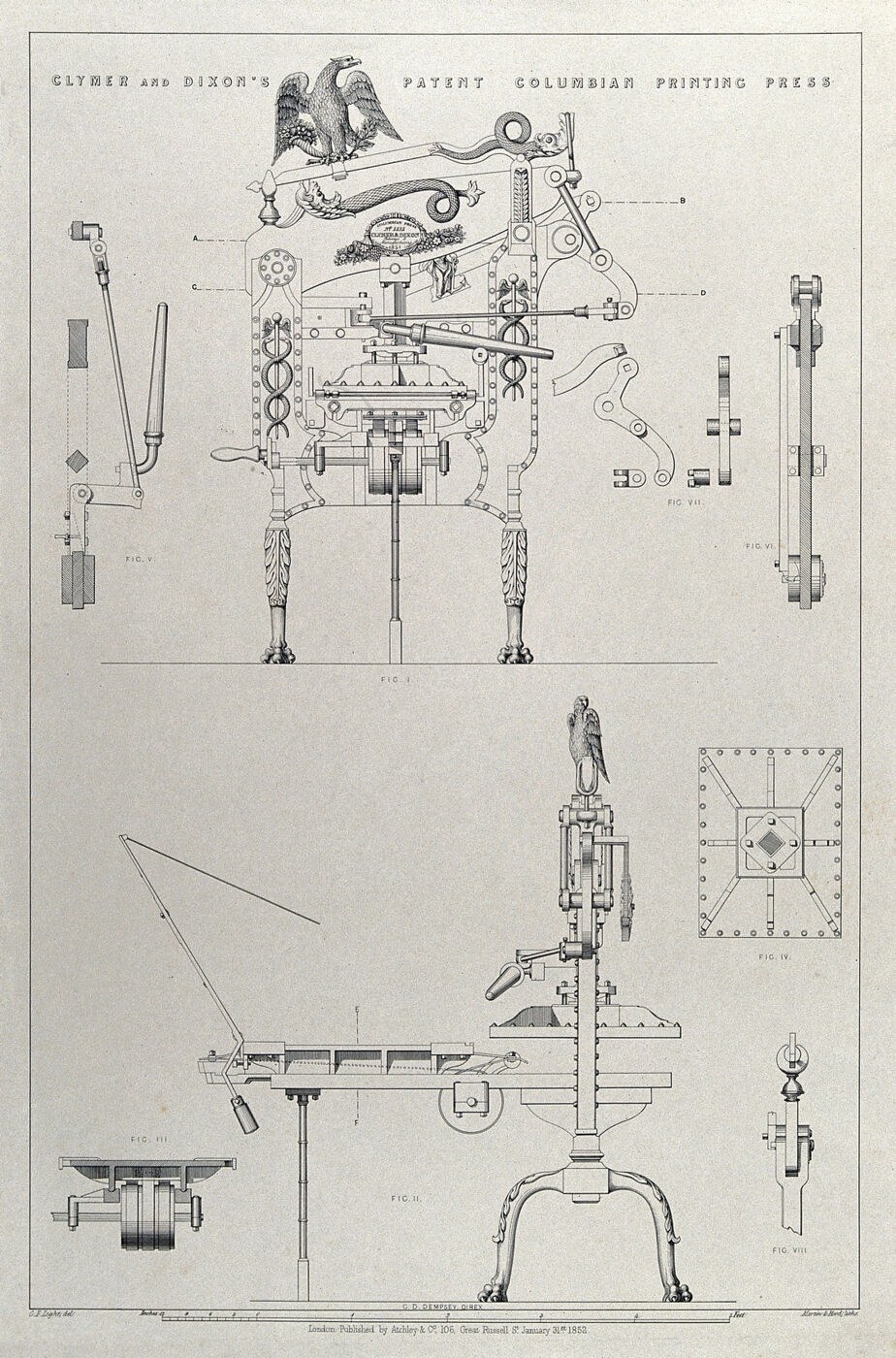
The eagle on a Columbian press was more than an ornament: it formed part of the counterweight system of an iron hand press designed to deliver strong, even pressure. George Clymer developed the design in the United States, then took its manufacture to Britain. This London plate, published in January 1852, gives several views of the machine rather than showing a working print shop. Its careful rendering makes a piece of industrial equipment into something that could be studied and compared on paper, while the name and decoration kept its American associations in circulation.
About the picture
The press’s heavy frame and connected levers transmitted the operator’s pull to the printing surface, while the eagle served as a counterweight. Several views on one sheet explained the same machine from different angles. Such plates allowed printers and readers to study equipment without standing beside a working example.
The history behind it
The documented reconstruction
The machine is a Columbian printing press represented in a London lithograph published on 31 January 1852. Its eagle ornament and product name are visually memorable but weaker geographical evidence than the explicit imprint. The multiple views explain a design rather than proving a succession of installations or an individual object’s manufacture date. The production credits also separate artist, lithographers and publisher; none automatically identifies the factory that built a particular press. This is a technical representation with a firmly dated publication history, not a performance test, sales ledger or proof of the date printing was invented.
Reading the source
The conspicuous eagle and geographical-sounding model name are memorable visual hooks. They are not the best evidence for where this particular plate was published. The imprint supplies that information directly. The artist, lithographers and publisher are also separately credited, which helps keep the production of an image distinct from manufacture of the machine it describes.
Questions for further research
Technical views invite a different kind of reading from a street photograph. Their purpose is to explain relationships among forms and components, not necessarily to depict multiple machines or dated stages. Publication history, individual manufacture, output rate and sales volume are separate questions. Only the first is firmly dated in the supplied packet.
A few things to read next
Books for a longer visit, and a few good places to start online. These are ordinary links, with no affiliate commission.
On the bookshelf
Printing 1770–1970: An Illustrated History of Its Development and Uses in England
The practical changes in printing equipment and printed products during the press’s working era.
The Printing Press as an Agent of Change
The much earlier print revolution, useful for tracing the longer consequences of reproducible text.
The Intellectual Life of the British Working Classes
What access to books and other printed matter meant in British working-class lives.
Read online
Columbian press
A starting point for names, dates and related subjects. Follow its references when you want to go further.
Cast iron Columbian printing press
The all-iron frame, levers and ability to print a whole sheet in one pull.
Columbian Press
A surviving example with notes on its eagle counterweight and maker’s inscription.
Where the pictures come from
The original records and their individual rights statements are below. The pictures have not been generated or altered for the game.
Clymer and Dixon's patent Columbian printing press.
Wellcome Collection · London (106 Great Russell St.) : Atchley & Co., January 31st 1852.
Public Domain Mark — free of known copyright restrictions.
An original editorial digest of the cited catalog facts; not a second historic eyewitness document.
Wellcome Collection · Editorial digest reviewed 2026-11-01
Original Data Barnacle wording summarizing factual catalog data; underlying artifact rights are stated on the image.
History notes and reading lists prepared for Data Barnacle with AI assistance. The source institutions and authors are not sponsors or endorsers. Suggest a correction or another source