Labor and reform 1911
Lewis Hine’s Pennsylvania breaker boys
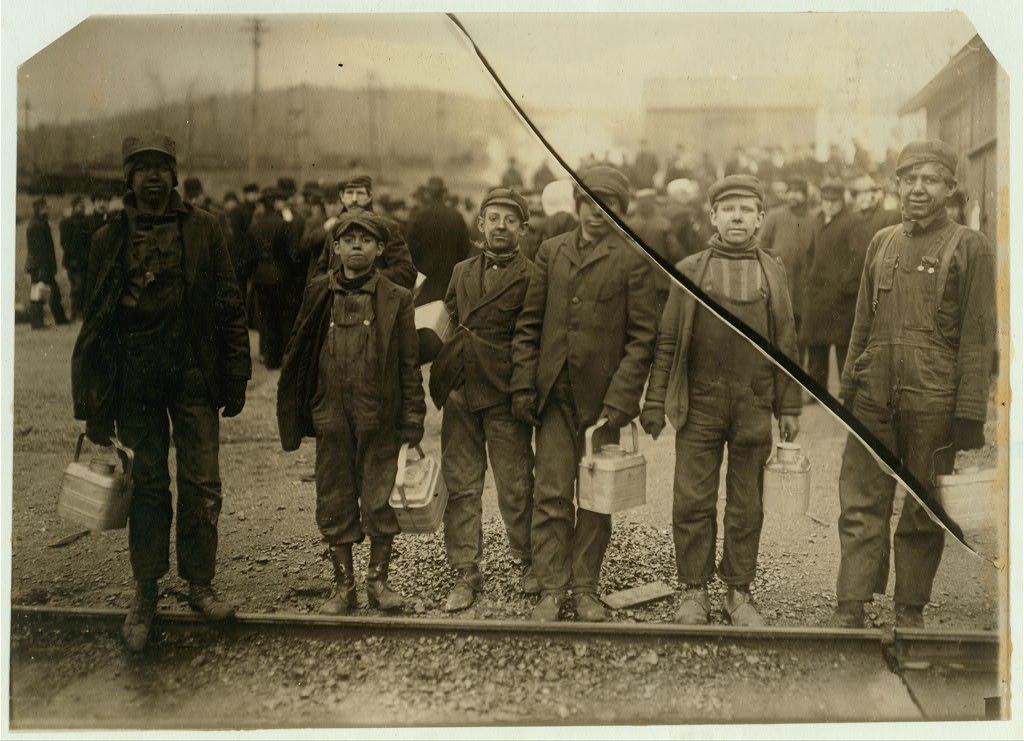
In January 1911, Lewis Hine photographed young workers outside the Bliss coal breaker near Nanticoke, Pennsylvania. Breakers processed mined coal, and boys were employed to pick out unwanted material. Hine worked for the National Child Labor Committee, combining photographs with notes to make working children visible to a wider public. The group portrait gives the campaign faces and individual bodies rather than only statistics. It also leads beyond the photograph to questions about family income, compulsory schooling and the long political struggle over which kinds of work children should be permitted to do.
About the picture
Hine gathered these boys outside the breaker rather than photographing them at the sorting machinery. His caption connects the portrait to the Bliss operation near Nanticoke. Combining a picture with a place and occupation was central to the National Child Labor Committee’s effort to document and challenge children’s industrial employment.
The history behind it
The documented reconstruction
This is Hine’s January 1911 group photograph associated with the Bliss breaker near Nanticoke. The portrait and the National Child Labor Committee caption have different jobs: one shows the group and its presentation, while the other identifies employment and locality. They do not conflict, but they should not be collapsed into a claim that the camera shows a working shift inside the breaker. Nearby Pennsylvania coal records can be plausible distractors because Hine documented multiple workplaces. Individual ages, consent circumstances, work hours and later outcomes require additional records. Respecting those limits strengthens the historical identification rather than weakening the reality of the documented labor investigation.
Reading the source
The portrait and caption should be kept in conversation without assigning them the same evidentiary role. Visible pose, clothes and arrangement belong to the exposure. Workplace, occupation, locality and date come through the preserved investigative record. Keeping those layers distinct lets the caption add information without pretending it is literally visible inside the frame.
Questions for further research
The case also cautions against transferring details from a nearby or similarly titled archive item. Different coal-breaker locations can appear within one photographer’s wider investigation. Individual age, hours, wages, later life and circumstances of consent demand their own evidence. The packet gives no reason to fabricate those personal details for the photographed boys.
A few things to read next
Books for a longer visit, and a few good places to start online. These are ordinary links, with no affiliate commission.
On the bookshelf
Child Labor: An American History
The legal, economic and social history behind American child-labor reform.
Picturing Class: Lewis W. Hine Photographs Child Labor in New England
A close study of Hine’s methods and photographs from another industrial region.
On Photography
A critical companion for thinking about how photographs ask viewers to respond to other people’s lives.
Read online
Breaker boy
A starting point for names, dates and related subjects. Follow its references when you want to go further.
About the National Child Labor Committee Collection
How Hine’s pictures, captions and investigative work became a reform archive.
Child Labor in America, 1908–1912
The conditions Hine documented and the campaign his photographs supported.
Where the pictures come from
The original records and their individual rights statements are below. The pictures have not been generated or altered for the game.
A few of the young breaker boys working in the Bliss breaker of the D.L. & W. near Nanticoke, Pa. Location: Nanticoke vicinity, Pennsylvania.
Library of Congress, Prints & Photographs Division · 1911 January.
No known restrictions on publication. For information see: "National Child Labor Committee (Lewis Hine photographs)," https://hdl.loc.gov/loc.pnp/res.097.hine
An original editorial digest of the cited catalog facts; not a second historic eyewitness document.
Library of Congress, Prints & Photographs Division · Editorial digest reviewed 2026-11-01
Original Data Barnacle wording summarizing factual catalog data; underlying artifact rights are stated on the image.
History notes and reading lists prepared for Data Barnacle with AI assistance. The source institutions and authors are not sponsors or endorsers. Suggest a correction or another source