Scientific instruments 1848
Learning to see through a microscope
A useful microscope needed more than a strong lens. Its maker had to control coloured fringes, steady the specimen and arrange the light; its user had to learn what to prepare and where to look. John Quekett’s 1848 manual brought these practical problems together for readers examining animal, plant and mineral structures. Quekett worked with microscopic preparations at the Royal College of Surgeons. His book belongs to a period when microscopy was becoming a shared laboratory practice, supported by instruments, preserved specimens and printed instructions.
About the picture
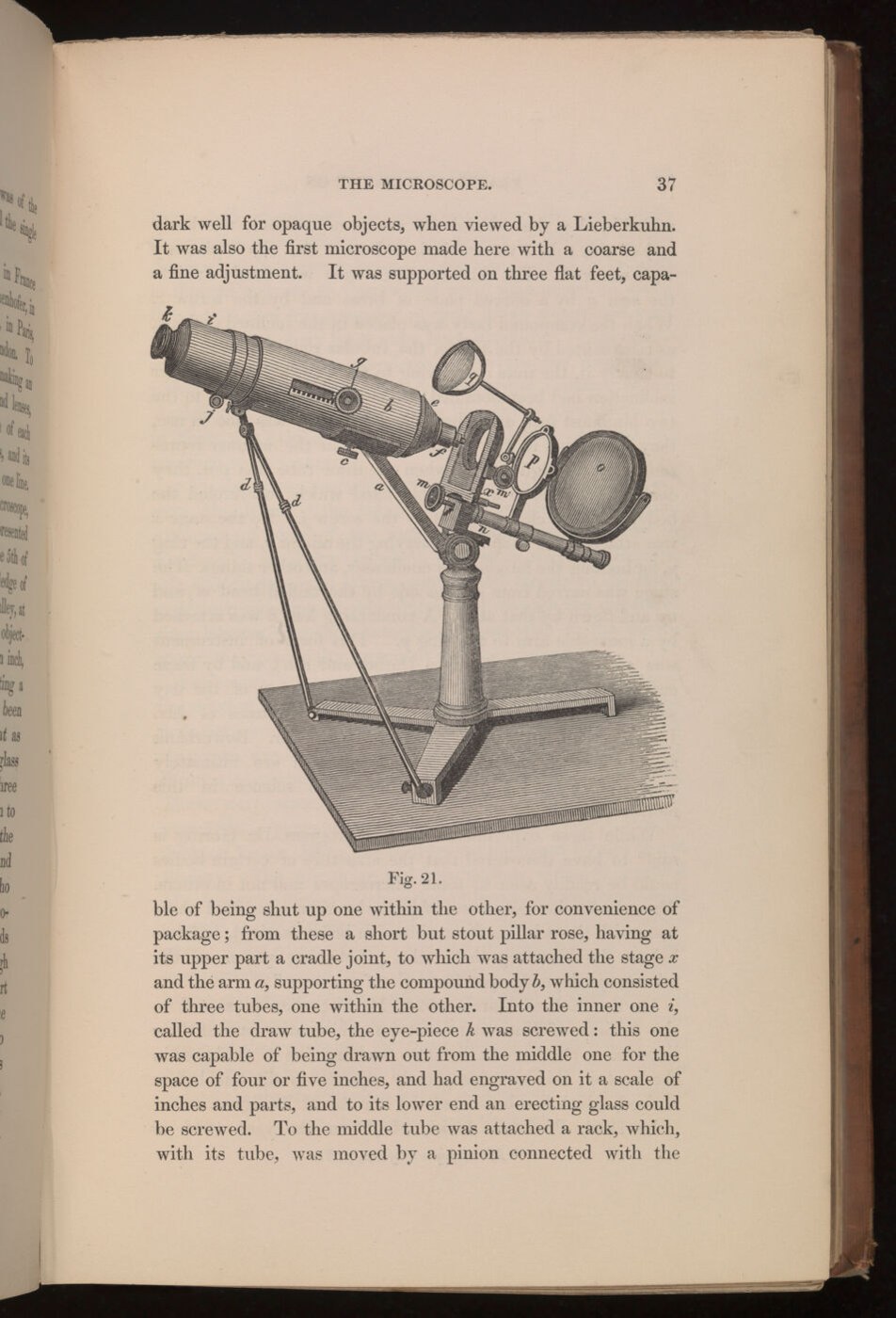
The stand and adjustments in Figure 21 are part of the history of reliable observation. An image that shakes or suffers from optical distortion can mislead its viewer. Quekett’s labelled illustration turns an elaborate instrument into something a reader could learn to handle, rather than merely admire.
The history behind it
The documented reconstruction
The secure date and place belong to Quekett’s London treatise of 1848. The artifact is page 37 with figure 21 and descriptive prose, cataloged as an illustration of Lister’s microscope. It documents the representation and explanation of an instrument; it does not prove that the illustrated machine was made that year, that microscopy was invented then, or that an experiment was carried out at the moment represented. The labels and mechanical discussion justify an instrument-focused reading rather than a clinical case history. To identify an individual surviving object or evaluate its performance, a researcher would need additional manufacturing or experimental records.
Reading the source
The page number, figure number and explanatory prose locate the instrument within an instructional publication. The London 1848 citation dates that publication. It does not, by itself, establish when an individual machine was built or when an entire field began. Even a detailed technical image should retain the bibliographic role of its source.
Questions for further research
A labeled drawing can communicate parts and adjustment mechanisms while leaving practical performance untested in the packet. It is not a specimen record, patient history, calibration report or purchase receipt. Those document types answer different questions. Moving carefully between them is the difference between identifying an illustration and inventing an experiment around it.
A few things to read next
Books for a longer visit, and a few good places to start online. These are ordinary links, with no affiliate commission.
On the bookshelf
A Practical Treatise on the Use of the Microscope
Read the original manual that contains the illustrated instrument.
The Invisible World: Early Modern Philosophy and the Invention of the Microscope
Explore how magnified observations changed arguments about nature and knowledge.
Micrographia
Compare Quekett’s teaching manual with an influential seventeenth-century illustrated investigation.
Read online
Microscopy
A starting point for names, dates and related subjects. Follow its references when you want to go further.
John Thomas Quekett (1815–1861)
Quekett’s work, teaching and collection of microscopic preparations.
A Practical Treatise on the Use of the Microscope
The library record for the 1848 manual and its publication context.
Where the pictures come from
The original records and their individual rights statements are below. The pictures have not been generated or altered for the game.
Illustration of Lister's microscope.
Wellcome Collection · Source treatise: London, 1848
Public Domain Mark — free of known copyright restrictions.
An original editorial digest of the cited catalog facts; not a second historic eyewitness document.
Wellcome Collection · Editorial digest reviewed 2026-11-01
Original Data Barnacle wording summarizing factual catalog data; underlying artifact rights are stated on the image.
History notes and reading lists prepared for Data Barnacle with AI assistance. The source institutions and authors are not sponsors or endorsers. Suggest a correction or another source