Craft and representation 1901
Navajo weaving and the trade in printed views
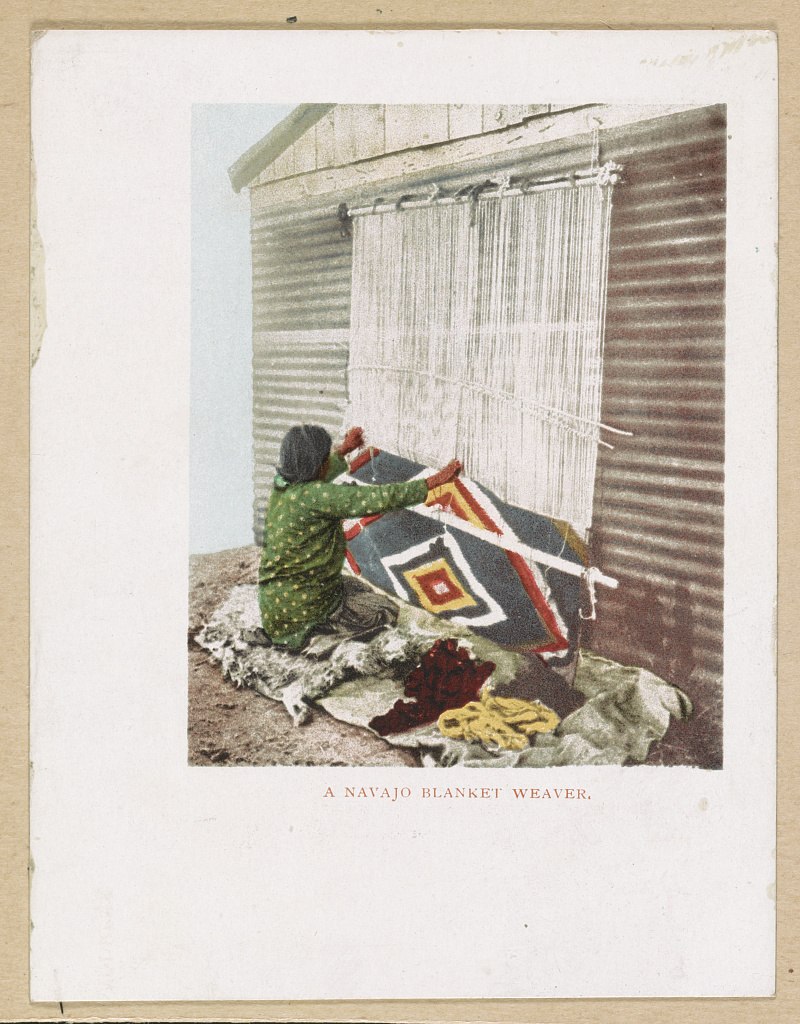
Navajo weaving has a history of skilled work, changing materials and designs, and relationships with markets far beyond the loom. During the nineteenth century, textiles made for clothing and trade also found growing markets among outside buyers. This printed view, published in Detroit in 1901, brought a weaver’s image into another commercial circuit: inexpensive pictures sold to a distant public. The person at the loom remains unnamed in the record. Reading textile histories alongside the image helps restore attention to the knowledge and decisions involved in making the cloth.
About the picture
The upright loom places the weaver’s working position and the growing textile at the center of the view. Navajo weaving changed as yarns, dyes and markets changed. The print’s color was part of its production as a commercial image, so studying the actual textiles is essential for understanding their materials and design.
The history behind it
The documented reconstruction
The correct reconstruction preserves a useful distinction: this is a weaving image published in Detroit in 1901, rather than proof that its depicted work took place in Detroit. The catalog itself qualifies the publication statement by tracing it to an associated item. Loom and textile details support the activity, while the historical title supplies the subject identification. Neither authorizes inventing a name, tribal biography, exact age, ceremonial setting or selling price. This case is solved by reading bibliographic geography as bibliographic geography, and retaining the missing information as missing rather than filling it with a plausible Southwestern location.
Reading the source
Bibliographic descriptions often place a city next to a company and a year. That combination identifies publication, not automatically the geography of the pictured work. This source makes the distinction especially important because its publication information was inferred through an associated item. The qualification is part of the record and should travel with a careful caption.
Questions for further research
The loom and textile support an activity identification, while the historical title provides the catalog’s subject label. Neither identifies an individual’s name, exact age, community, experience or intentions. The absence of a precise exposure site is not solved by selecting a plausible Southwestern settlement. Further identification would need a connected negative record, caption or documented provenance.
A few things to read next
Books for a longer visit, and a few good places to start online. These are ordinary links, with no affiliate commission.
On the bookshelf
Blanket Weaving in the Southwest
A substantial study of Southwestern textiles, with close attention to materials, dyes and chronology.
Navajo Weaving: Three Centuries of Change
The development of Navajo weaving across three centuries of social and commercial change.
Photography and Anthropology
Background on how photographs have represented people and cultures to outside audiences.
Read online
Navajo weaving
A starting point for names, dates and related subjects. Follow its references when you want to go further.
Tradition & Trade
A museum introduction to Diné weaving knowledge and changing trade relationships.
A Brief History of Navajo Rug Weaving
Historical context for the transition from blankets and garments toward the rug market.
Where the pictures come from
The original records and their individual rights statements are below. The pictures have not been generated or altered for the game.
A Navajo blanket weaver
Library of Congress, Prints & Photographs Division · [Detroit: Detroit Photographic Co., 1901]
No known restrictions on publication.
An original editorial digest of the cited catalog facts; not a second historic eyewitness document.
Library of Congress, Prints & Photographs Division · Editorial digest reviewed 2026-11-01
Original Data Barnacle wording summarizing factual catalog data; underlying artifact rights are stated on the image.
History notes and reading lists prepared for Data Barnacle with AI assistance. The source institutions and authors are not sponsors or endorsers. Suggest a correction or another source