Everyday infrastructure 1900–1930
A water carrier in Cairo
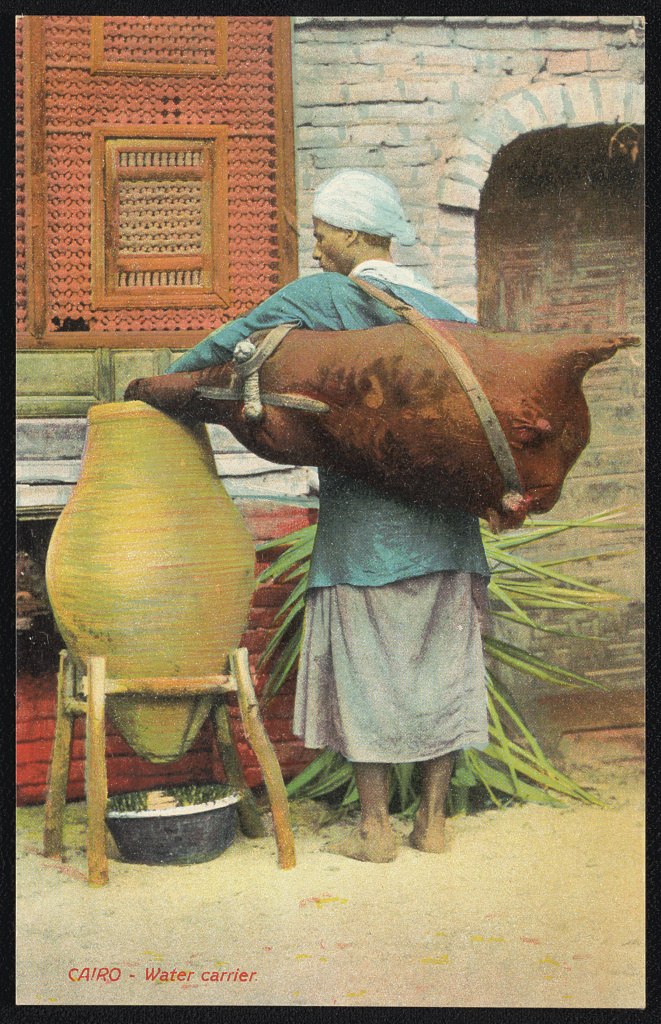
Before water arrived reliably through household pipes, carrying it was a form of essential urban work. Cairo’s water carriers belong to that long history of people moving a daily necessity through a crowded city. This early twentieth-century postcard presents one carrier with the vessels associated with his occupation. It was also an image made for circulation, giving distant viewers a compact, recognizable picture of an unfamiliar place. The subject invites a longer question about city life: who fetched water, who could pay to have it delivered, and how those arrangements changed as piped systems expanded.
About the picture
The carrier’s containers make the physical work of water supply visible. Water had to be collected, carried and delivered before it could be used at home. The postcard turns that occupation into a portrait, preserving an aspect of everyday infrastructure that is easy to overlook in histories centered on monumental buildings.
The history behind it
The documented reconstruction
The safest label is an early twentieth-century Cairo water-carrier postcard. The objects and the catalog reinforce one another, but they support an occupational view rather than a complete account of Cairo’s water supply. Its 1900–1930 dating is deliberately broad, and the absence of an identified original source is part of the evidence rather than a gap to fill with a confident name. The image cannot establish a route, earnings, ownership of the equipment or the availability of piped water elsewhere in the city. Good archival work keeps those unresolved questions separate from the supported identification.
Reading the source
The most useful sequence is to identify the containers, compare that reading with the historic title and then retain the catalog’s broad date range. Costume may attract attention first, but the equipment does more to connect the image to a practical task. The unidentified original source remains an important qualification in the attribution.
Questions for further research
An occupational postcard is a selected view of one person or activity. It can show that water carrying was represented as a recognizable occupation without describing every household’s access to water. Routes, customers, earnings and the ownership of equipment cannot be reconstructed from this isolated exposure. A caption that keeps those questions open is more informative than a sweeping urban claim.
A few things to read next
Books for a longer visit, and a few good places to start online. These are ordinary links, with no affiliate commission.
On the bookshelf
Colonising Egypt
Nineteenth-century Egypt, colonial power and the remaking of everyday institutions.
Imperial Eyes: Travel Writing and Transculturation
How travel writing presented other societies to readers abroad; useful context for commercial postcards.
Water 4.0: The Past, Present, and Future of the World’s Most Vital Resource
A broader history of the systems that moved cities from carried water toward modern supplies.
Read online
Water carrier
A starting point for names, dates and related subjects. Follow its references when you want to go further.
Cairo: Water carrier
The original postcard record, with the Library’s dating and reproduction details.
From water carriers to tap water
A newspaper archive history of Cairo’s changing water supply.
Where the pictures come from
The original records and their individual rights statements are below. The pictures have not been generated or altered for the game.
Cairo. Water carrier
Library of Congress, Prints & Photographs Division · [between 1900 and 1930]
No known restrictions on publication.
An original editorial digest of the cited catalog facts; not a second historic eyewitness document.
Library of Congress, Prints & Photographs Division · Editorial digest reviewed 2026-11-01
Original Data Barnacle wording summarizing factual catalog data; underlying artifact rights are stated on the image.
History notes and reading lists prepared for Data Barnacle with AI assistance. The source institutions and authors are not sponsors or endorsers. Suggest a correction or another source